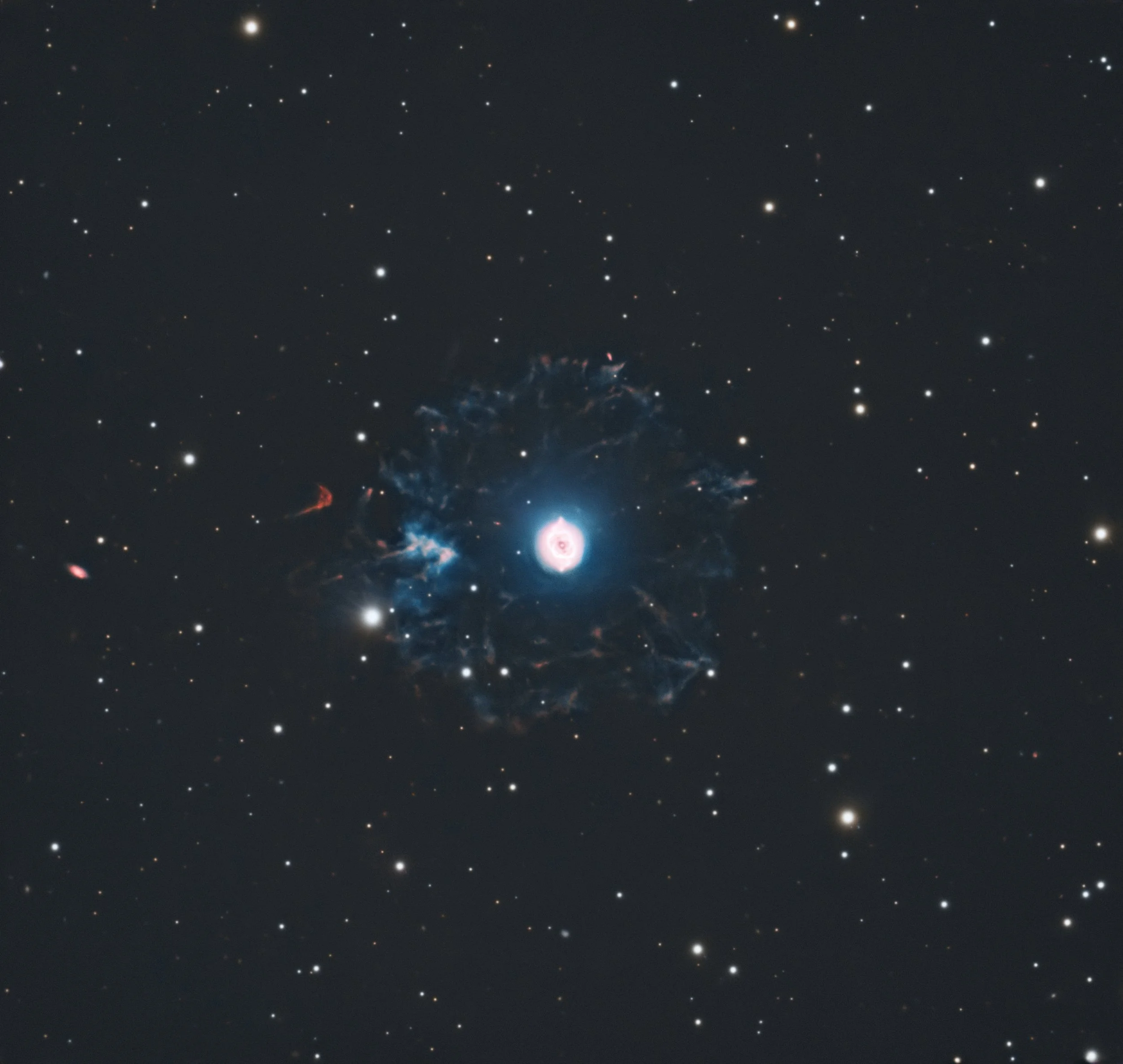
The “Cat's Eye” Nebula, also known as NGC 6543 or Caldwell 6 (C6 in the Caldwell catalog), is a planetary nebula located in the constellation Draco.
This nebula was discovered by the German-British astronomer William Herschel in 1786.
Heinrich Louis d'Arrest also observed this nebula at a later, unknown date.
NGC 6543 was the first planetary nebula whose visible spectrum was studied by the British astronomer William Huggins in 1864. He discovered that the nebula had a gaseous shell and, therefore, that this type of object had no connection to a planet.
This spectacular and complex planetary nebula consists of multiple layers of glowing gas, formed by the violent ejection of gas from the outer layers of its central star (the size of the Sun), which has become a white dwarf in the final stage of its life cycle. Like other planetary nebulae such as NGC 6751 (nicknamed the “Sparkling Eye Nebula”) or NGC 7293 (nicknamed the “Eye of God”), it derives its name from its shape, which resembles a cat’s eye.
The surface temperature of the nebula's central core is approximately 80 000 Kelvin, and it is about 10 000 times brighter than the Sun.
The temperature inside the bright part of the nebula ranges from 7 000 to 9 000 Kelvin, and its density is approximately 5 000 particles per cubic meter.
Its outer halo, however, is much hotter—around 15 000 Kelvin—and has a lower density. The stellar wind speed is approximately 1 900 km/s.
Distance and Age
According to some sources, it is located about 1,000 parsecs away from us ; others estimate this distance to be
3 000 light-years.
A recent study of four planetary nebulae, which took into account parallax measurements from the Gaia satellite and the expansion of the nebulae, arrived at a distance of 1.19 ± 0.15 kpc. Finally, a third distance, based on parallax measurements from the same satellite, is listed in the Simbad database : 1,365 ± 54 pc (∼4 450 light-years)
Its age is estimated to be approximately 1 000 years.,
Based on the kinematics of the nebula’s inner core, its age has been estimated at 1 039 pc ± 259 years.
According to Corradi and his colleagues, the age of the nebula’s halo is 85 000 years, and that of the inner nebula is 2 000 years.
Set up
Celestron C8 at full focal length on an Eq6 R Pro mount
ASI 533 MC for imaging
ASI 220 mini for guiding via the Celestron OAG
Optolong L Quad
Asiair Plus
Preprocessing and Processing : Pixinsight
The session
“The Cat's Eye” was taken on July 12, August 13, and August 14, 2026
100 images with a 5-second exposure
64 images with a 1-minute exposure
224 images with a 2-minute exposure
44 images with a 5-minute exposure
I chose to take both short-exposure and long-exposure shots (merged into a single HDR image) in order to avoid overexposing the center of the nebula while preserving the details of both the core and the outer envelope.
Total integration : a little over 12 hours and 20 minutes of imaging
Clear Sky !
Leave a comment