The Rosette Nebula
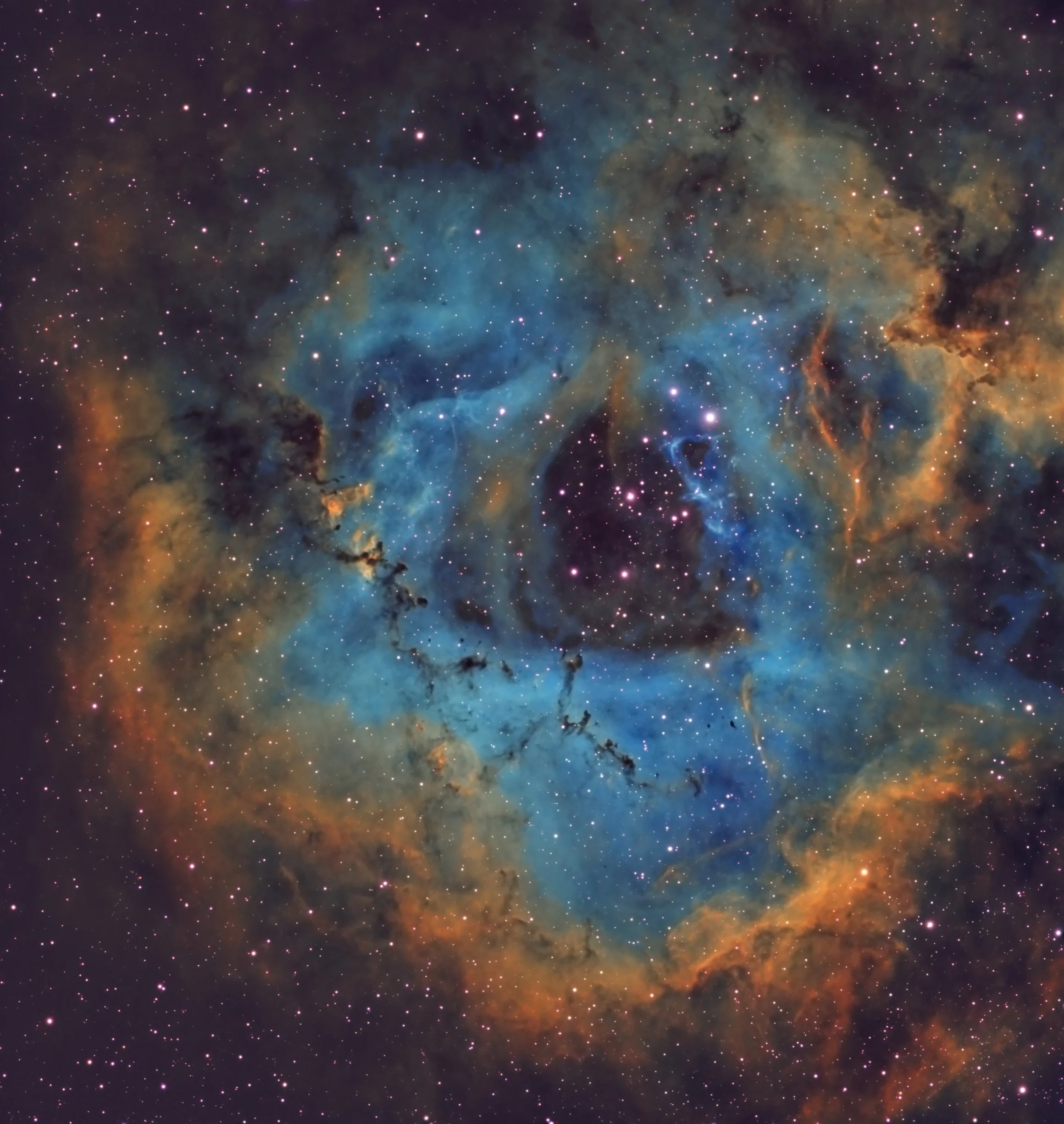
The Rosette Nebula, also known as NGC 2237 and Caldwell 49, is a vast HII region located some 4 700 light-years from the Solar System in the direction of the constellation Monoceros.
NGC 2237 was discovered by the American astronomer Lewis Swift in 1865.
Characteristics of the Nebula
The angular size of the Rosette Nebula is 130’ × 110’, and at the estimated distance of this emission nebula, it spans 130 light-years along its longest dimension. These figures apply to the nebula as a whole and not to NGC 2237, which is only a part of it. According to the SEDS website, the size of NGC 2237 is 80' × 50'.
The mass of the Rosette Nebula is estimated to be about 10,000 times the mass of the Sun.
NGC Objects in the Rosette Nebula
The Rosette Nebula is an active stellar nursery relatively close to us. Since this cloud complex is vast and spectacular to observe, it is not surprising that several entries in the NGC catalog are found there. The nebula includes the following entries:
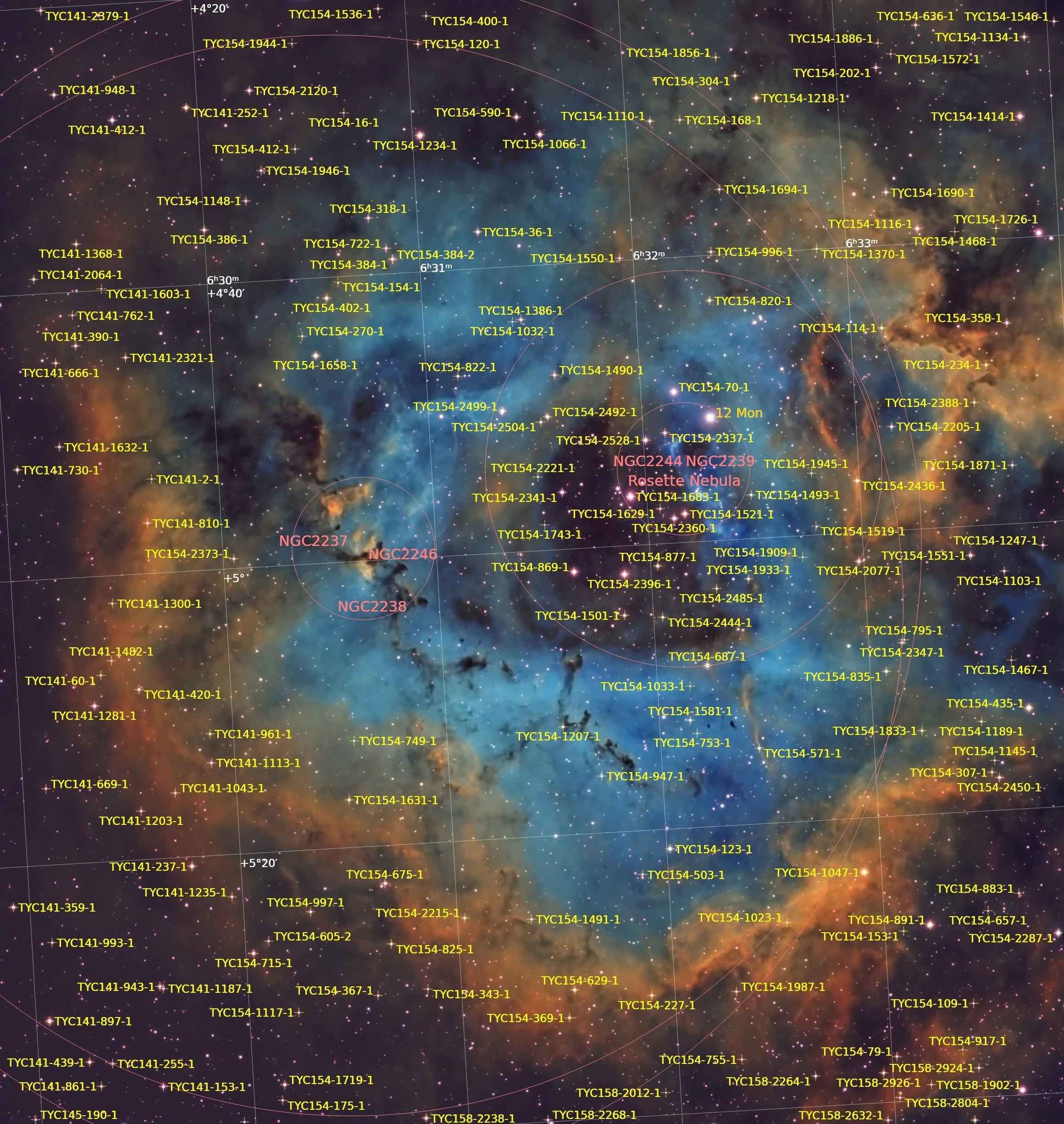
NGC 2237: the western part of the nebula, although this entry is used, as on this page, to refer to the entire nebula. The discovery of NGC 2237 is attributed to Lewis Swift.
NGC 2238: another part of the Rosette Nebula discovered by Albert Marth.
NGC 2244 (=NGC 2239): a very young open star cluster within the nebula, the discovery of which is attributed to John Flamsteed. The age of this cluster is approximately 8 million years. It is the ultraviolet radiation from the stars in this cluster that ionizes the hydrogen in the nebula (HII region) and gives it its red color.
NGC 2246: another emission region of the Rosette Nebula, the discovery of which is attributed to Lewis Swift.
Set up
Fra400 on Celestron AVX Mount
ASI533 MC Pro camera for imaging
ASI120 mini camera for guiding via OAG Zwo
Control via ASIAIR PLUS
Gain (ISO) : 101
Camera cooling : -10°C
Antlia Duoband 5 nm
Askar D1
Askar D2
Preprocessing and Processing : Pixinsight
The session
NGC2237 was taken in 2024 with Antlia Duo band 5 nm (Hydrogen alpha and Oxygen 3).
I completed it with the Askar D1 (Hydrogen alpha and Oxygen 3) & D2 (Sulfur 2 and Oxygen 3) in January 2026.
Total Integration : 12 hours
The Rosette in Hubble Palette
Annotated Version
Clear Sky !
Leave a comment